The Great Convergence: Why Expo is just "React for Screens"
For years, we drew a hard line between "Web" and "Mobile." Web was about DOM nodes and URLs; Mobile was a dark forest of Gradle files, CocoaPods, and fragile build chains. But in 2026, that wall has finally crumbled. If you understand Next.js, you already understand Expo.
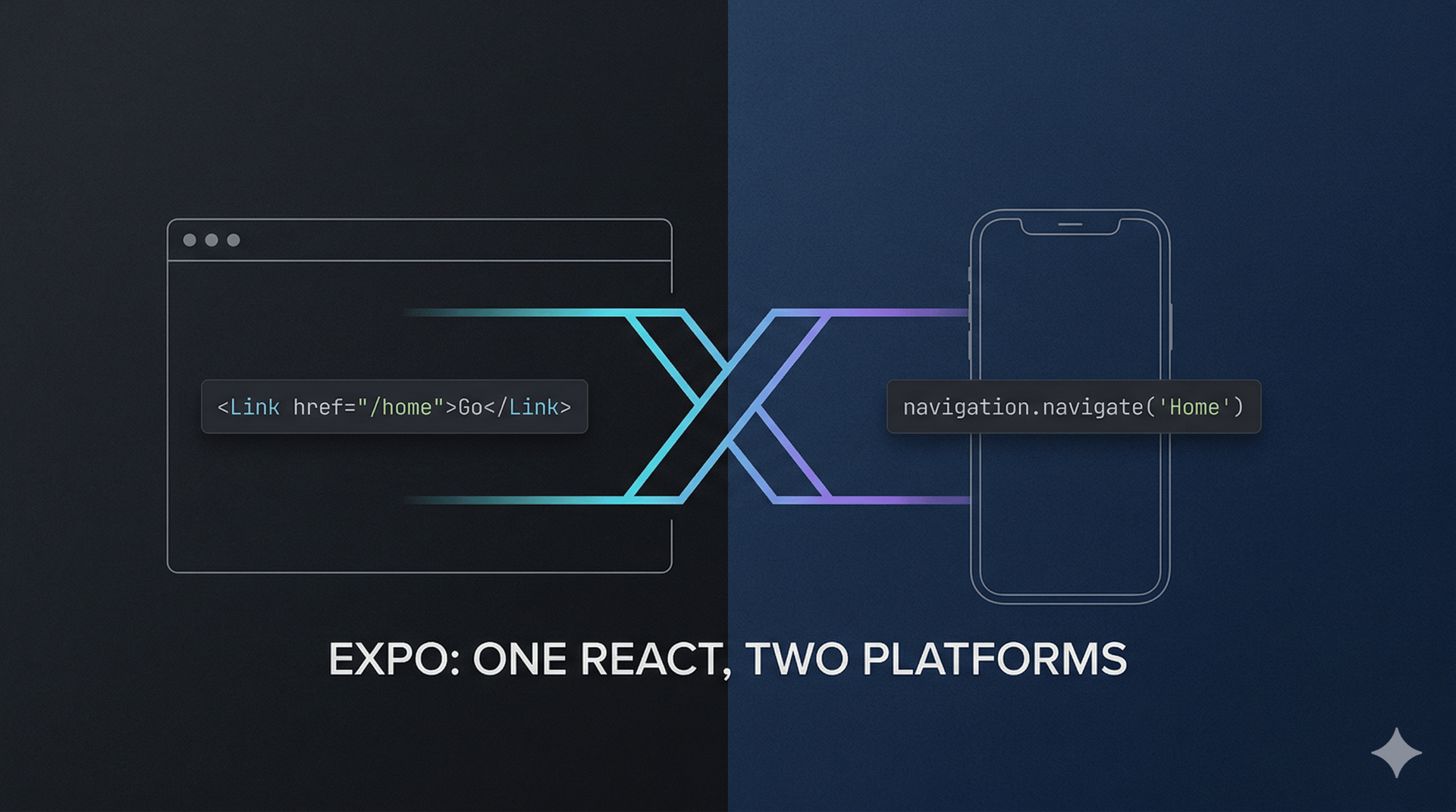
Building mobile apps used to feel like a completely different career path for a web developer. You had to learn Xcode, fight with Gradle, and pray your environment didn't break every time you updated a dependency.
In 2026, that barrier is basically gone. Moving from React to Expo isn't a "pivot" anymore; it’s just a weekend project.
The Learning Curve: It’s mostly just React
If you know React, the learning curve for Expo is incredibly flat.
- Routing: If you’ve used Next.js, Expo Router will feel like home. It’s file-based, intuitive, and handles deep linking without the usual three-day configuration headache.
- Styling: This was always the "hard" part: realizing that CSS doesn't exist in mobile. You’re working with
StyleSheet(basically a subset of CSS-in-JS). But even that has a shortcut now. I’ve been leaning into NativeWind, which lets you use Tailwind classes. It bridges the gap so well you almost forget you’re targeting a "glass rectangle" instead of a browser.
The Good Stuff (Pros)
- Zero Native Friction: You don't need to open Android Studio or Xcode for 90% of your development.
- EAS (Expo Application Services): This is essentially Vercel for mobile. You run a command, the cloud builds your binary, and you get a link to install it. No more "it builds on my machine but not the CI."
- Fast Refresh: The iteration speed is legitimately faster than some web dev setups I’ve worked on.
The Reality Check (Cons)
It’s not all magic, though. There are a few things that still bite:
- App Size: Expo apps are notoriously larger out of the box. You're carrying around the Expo SDK, which adds some weight compared to a "bare" React Native app.
- The Native "Wall": Eventually, you might need a very specific native library that isn't in the standard Expo SDK. In the past, this meant "ejecting" (a nightmare). Now, we have Development Builds, which are better, but they still require you to understand a bit more about the underlying native structure.
- The Update Cycle: Mobile moves fast. Keeping your SDK versions synced with the latest iOS and Android requirements requires more active maintenance than a typical web app.
The Verdict
The most valuable realization for me wasn't that Expo makes mobile easy: it’s that it makes the platform irrelevant.
We aren't "Frontend Devs" or "Mobile Devs" anymore. We are Product Engineers. If you can build a high-performance React web app, you are already a mobile engineer.
You just haven't run npx create-expo-app yet.